A Chiba startup has rebuilt yokan into an energy bar now test-selling in Japan and Australia. Here is why this centuries-old confection is one of the smartest survival foods ever made.
Ibaraki has become the first prefecture in Japan to pay residents a cash reward for reporting illegal foreign employment. Inside the design, the governor's defense, the backlash from lawyers, and the farming-economy contradiction underneath it all.
Japan's PM Takaichi wants to scrap food consumption tax for two years—but POS vendors say the register overhaul takes a year. Why does changing a number take so long? We compare Japan's tangled POS systems with the US, where a tax change takes an afternoon. The twist: America's speed is a side effect of its chaotic tax code.
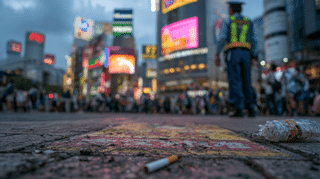
On June 1, Shibuya became the first place in Japan to fine street littering on the spot, 2,000 yen a pop, with 10 penalties on day one. But this is a country that spent decades removing its public bins. Inside Japan's awkward don't-litter-but-good-luck-finding-a-bin paradox.
Akita Prefecture has adopted environmental DNA surveys that estimate whether bears passed within 1km upstream in the past 24 hours from a single glass of river water. We explain how it works, its limits, and how it compares with grizzly-detection efforts abroad.
An unpermitted mosque facing removal in Japan exposes the real problem: the issue isn't faith, it's the permit — and the lawful route to building one is often blocked. A look at Japan's rising Muslim population, its population decline, and the legal path that was never built.
Japan's 2025 census preliminary count puts the population at 123 million, down 3.1 million in five years — the steepest drop since records began. The country fell from 11th to 12th in the world, overtaken by Ethiopia. We translate that number into cities you can picture, then compare how South Korea, Italy, and China face the same cliff, and ask whether Japan's immigration, birth-support, and regional-revival policies are working.
In Japan's science city of Tsukuba, a coffee roaster and the KEK physics lab created five drip-bag blends named after subatomic particles, each tuned to the particle's real character. Why visiting researchers love them as souvenirs.
While matcha sells out worldwide, the kyusu, the side-handled teapot once found in every Japanese home, is quietly disappearing. What a kyusu is, where its odd shape came from, why it fell out of use, and why you should try a cup brewed in one when you visit Japan.
Electronics giant Panasonic hosted a Tokyo adoption event where 193 rescue dogs and cats met would-be families. A look at why a tech company backs animal welfare, and the company-NPO-newspaper model behind it.
Tokyo's tree canopy fell from 9.2 percent in 2013 to 7.3 percent in 2022, a 20 percent drop in nine years, and Japan has roughly 500,000 fewer street trees than at its peak. As Singapore, Paris and New York expand their canopies, why do Japanese cities keep losing shade? A look through public data and recent research.