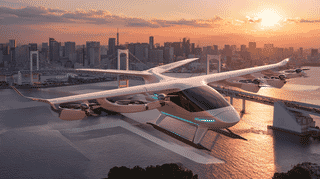
Japanese startup AirX has signed a binding order with Brazil's Eve Air Mobility for two eVTOL "flying car" aircraft, with options to expand to 50 units in a deal potentially worth $150 million. Targeting 2029 for sightseeing and last-mile transport services in Tokyo and Osaka, this agreement marks a major milestone in Japan's push toward urban air mobility — following successful demo flights at Expo 2025 Osaka.
Japanese startup AstroX has raised $15 million in Series A funding to develop its revolutionary Rockoon launch system — using high-altitude balloons to carry rockets to the stratosphere before firing them into space. Based in Fukushima's Minamisoma, the company aims to reach space by 2026 and achieve orbital insertion by 2029, challenging the global space launch industry with a low-cost, flexible alternative.
A joint team from Chiba University, NHK Science & Technology Research Labs, and Kyoto University has developed an organic EL device capable of both light emission and solar power generation. Using innovative MR-TADF materials, they overcame the long-standing trade-off between emission and power conversion efficiency, achieving the world's first blue light-emitting power-generating device. Applications include self-powered displays and battery-free sensors.
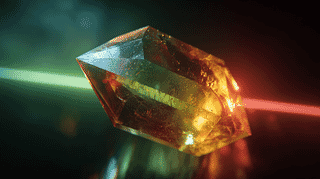
A Japanese research team has developed a single organic crystal that glows red under UV light and green under near-infrared light. This dual-mode material could transform optical sensing, energy harvesting, and medical imaging. Here's what makes it groundbreaking.
Japanese space startup ALE announces "Starlight Challenge," its third attempt to create the world's first artificial shooting stars after two previous setbacks. Targeting a 2028 space demonstration and commercialization by 2029, this ambitious project blends space entertainment with atmospheric science research.
A groundbreaking survey of 312 neuroscientists reveals that 41% believe long-term memories could be decoded from preserved brains after death. Could Whole Brain Emulation (WBE) achieve digital immortality by 2125? From engrams and connectomes to the hard problem of consciousness, we explore the science behind uploading your mind.
The US CCA program, China's loyal wingmen, and Japan's GCAP-linked combat drones. As nations race to develop AI-powered unmanned combat aircraft, we examine where Mitsubishi Heavy Industries and Kawasaki Heavy Industries stand, and the structural challenges Japan's defense industry must overcome.
A Japanese-led research team has detected the largest sulfur-bearing organic molecule ever found in interstellar space, a 13-atom ring compound near the Milky Way's center. The discovery bridges simple space chemistry and complex building blocks of life found in comets and meteorites, offering a key missing link in understanding life's cosmic origins.
A research team at Osaka University's QIQB has proposed a scalable photonic routing architecture for ion trap quantum computers. By comparing two multi-wavelength laser delivery methods, they demonstrated a path to controlling hundreds to thousands of qubits on a single chip—potentially reshaping the future of trapped-ion quantum computing.
University of Tokyo-born startup Pale Blue enters the Orbital Transfer Vehicle (OTV) business after being selected for JAXA's Space Strategy Fund. With its unique water-based propulsion technology, the company aims to create "branch line transportation" in space. A deep dive into Japan's growing space industry.
Kawasaki Heavy Industries is developing CORLEO, a four-legged personal mobility vehicle powered by hydrogen. After achieving 1.2 billion social media impressions at Osaka Expo 2025, the company targets deployment at Riyadh Expo 2030 and commercial sales by 2035. Discover the futuristic robot horse and global reactions.