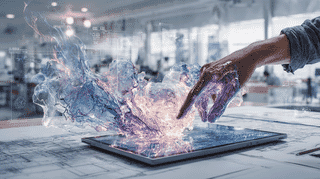
NHK STRL and Institute of Science Tokyo have built the world's first transparent hologram that floats full-color 3D images in front of clear glass. A new amplitude-aware design cracks the two old walls of surface-relief holography in one move.
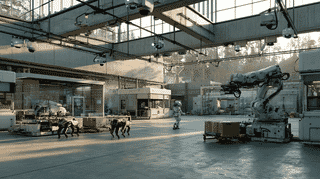
Fujitsu's new Kozuchi Physical OS isn't trying to build a smarter robot brain. It's trying to make the whole physical space intelligent. Here's how its edge-plus-sovereign-cloud design differs from NVIDIA Cosmos and Google DeepMind's Gemini Robotics — and how it fits into Japan's $126B Physical AI ambition.
A black clay layer in a remote Hokkaido stream — more than 10,000 km from the Yucatan impact crater — holds chemical fingerprints of the asteroid that ended the age of dinosaurs. Tohoku University researchers are re-analyzing East Asia's only known K-Pg boundary outcrop.
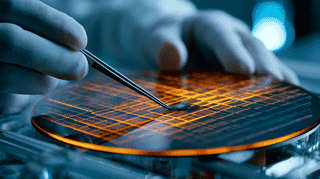
Kyoto University associate professor Mitsuaki Kaneko is commercializing SiC-based mixed-signal LSIs that work where silicon fails. His complementary JFET approach targets ADC samples in 2028-2029, opening a niche the big five SiC power players have largely ignored.
Akita Prefectural University students nicknamed the 'Avocado Squad' published a method that predicts avocado ripeness from skin reflectance and storage temperature—no slicing required. Now patent pending and seeking commercial partners.
A black, sponge-like slab that floats with just lamp light has racked up 1.8 million views in a week. Developed at Nagoya University by Tomonaga Ueno, the carbon-nanotube aerogel is lighter than air and could quietly reshape EVs, eVTOL aircraft, drones and spacecraft. Here's how it actually works—and why the startup Sora Material thinks it's an industrial workhorse, not just a viral trick.
The SI second hasn't changed since 1967. By 2030 it likely will. From Earth's rotation to atomic vibrations to optical transitions—this is the history of how we've defined the second, and a field guide to the candidate atoms and national labs racing to define it next.
NTT unveiled a world-first technique that uses just a smartphone camera to create illusions of softness and stickiness. How does this 'pseudo-haptics' approach differ from mainstream vibration motors and force feedback, and what problems does it solve?
JAL launches Japan's first humanoid robot trial at Haneda Airport in May 2026. Chinese-made Unitree G1 and UBTECH Walker E will handle cargo loading and cabin cleaning — Japan's bipedal answer to its aging workforce and aviation labor crisis.
Susumu Kitagawa of Kyoto University, joint winner of the 2025 Nobel Prize in Chemistry, has long advocated turning air itself into a resource through metal-organic frameworks (MOFs). His porous crystals can sort and capture CO2, water vapor and other molecules, putting Japan in direct conversation with players like Switzerland's Climeworks in the rapidly evolving direct-air-capture industry. Here is how a basic-science breakthrough from Kyoto could rewrite the economics of decarbonization.
Panasonic has partnered with Kyoto University's iPS Cell Research Foundation to begin proof-of-concept trials for fully automating iPS cell establishment at Osaka's Nakanoshima Cross. The goal: slash per-patient costs from tens of millions of yen to around 1 million yen. How does Japan's approach compare with US rival Cellino's laser-driven biomanufacturing?