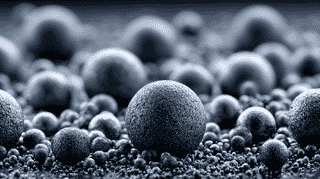
Sinfonia Technology, better known for semiconductor robots, has paired a cold crucible melting furnace with a disk atomizer to make highly spherical powder from high-melting metals like titanium and molybdenum. A look at the unglamorous powder that feeds metal 3D printing, and Japan's stake in it.
A Japanese-led team has resolved the first atomic-level structure of a metabolon, the elusive enzyme cluster that hid from biology for 40 years, revealing a new control principle called the GATE mechanism.
In a 2004 book, a Japanese paleontologist described his country's dinosaurs in modest terms. Two decades on, Kamuysaurus and Yamatosaurus put Japan on the global dinosaur map.
A Science Tokyo team finds that the brain runs multiple clocks for elapsed time, shifting between coherence and independence. From M2 and PPC recordings to the Twin-RNN model and a clue for brain-inspired AI, here's what they saw in a mouse.
Researchers in Japan made a four-micrometer sphere of chiral polymer that lases in a flat ring, like Saturn. The molecules self-assembled into a surface swirl that gives the light a direction. A clear look at the first angle-selective lasing from a sphere, driven by its own surface chemistry.
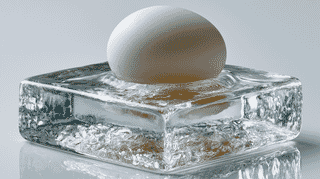
αGEL is the Japanese gel that keeps a raw egg intact after an 18-meter drop. The same material hides in mechanical pencils, G-SHOCK watches and ASICS shoes, and now damps drone vibration.
A team led by Japan's QST has shown, for the first time, a magnetic memory that writes with a laser pulse instead of current — and made it work on CoFeB, the alloy already inside commercial chips. Here's how, and why it matters for data-center power.
Discovered by accident during a COVID-era experiment, a University of Tokyo and Navarra study found about 65% of people drift counterclockwise when walking freely. Handedness and culture don't explain it, and even five-year-olds do it.
A Japan-US team from Tohoku University and the US NIST built the first working spintronics probabilistic bit (P-bit) on a single silicon substrate using standard chip-fabrication processes. We explain the coin-flip idea, how it differs from quantum computing (room temperature, existing chip lines), and how far it really is from a product.
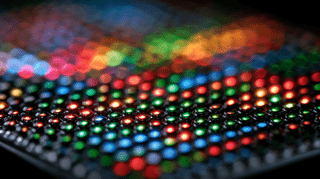
Kyoto University's Takuji Hatakeyama and colleagues linked multiple-resonance units to reach a 5.5nm emission band in solution, pushing spontaneous emission toward laser-like color purity. Published in Science, it points to purer, more efficient next-gen displays.
In 1998, Akira Furusawa achieved the world's first unconditional quantum teleportation at Caltech. For two decades, no one knew what it was for. By 2024, that same trick was running an optical quantum computer on the cloud. From the teleportation misconception to the reframe that turned it into a processor, and the startup OptQC's push for a homegrown machine.