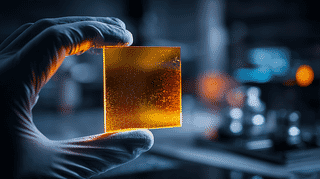
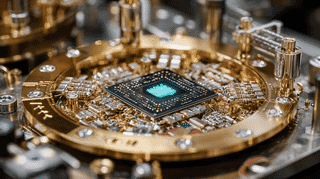
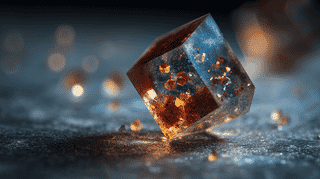
How does Fujitsu's dual-band T2SL infrared sensor stack up against existing products? We break performance down into three axes, resolution, sensitivity, and wavelength, and go head-to-head with FLIR, Raytheon, L3Harris, Northrop Grumman, and Sweden's IRnova. Plus the commercial rollout roadmap from FY2026.
Tokyo-based Orbray has produced the world's largest 30mm square (111) freestanding diamond single-crystal substrate, leaping from the previous few-millimeter limit. The twin-suppression breakthrough, published in Applied Physics Express, unlocks NV-center quantum sensors and next-generation power semiconductors.
Tokyo deep-tech startup H.I.Council has performed the world's first 108-qubit FeMoCo calculation on IBM's Heron r2 processor. While achieving chemical accuracy via classical methods, the team discovered a quantitative hardware limit they call the 'coherence wall' — a constructive finding for quantum hardware development.
RIKEN and Osaka University have launched cloud access to Ei-II, a domestically developed 144-qubit superconducting quantum computer. Doubling the previous 64-qubit Ei, the 28x28mm chip enables quantum calculations beyond classical simulation. We compare it with IBM and Google systems and examine Japan's quantum roadmap.
A Japanese research team has achieved what was considered impossible for over a century: creating a transparent, millimeter-sized bulk piece of amorphous alumina. With a dielectric constant of 11.3, surpassing sapphire, and a novel pentahedral pyramid structure, this JACS-published breakthrough could reshape semiconductor and capacitor materials.
Japanese robotics startup Jinki Ittai unveils its Bilateral Arm — a collaborative robot that transmits force feedback to operators — at Japan IT Week 2026. Also on display: a transformable humanoid heavy machine designed by Macross anime creator Shoji Kawamori. Partnering with Advantech (42.5% global IPC share), the company pursues a distinctly Japanese approach to robotics: human-operated force control rather than full autonomy, setting it apart from Boston Dynamics and Tesla Optimus.
DENSO and the University of Tokyo signed a 10-year partnership starting April 2026 centered on Dynamic Wireless Power Transfer (DWPT). Learn how charging EVs while driving could shrink batteries, cut costs, and reshape energy infrastructure — plus how Japan's approach compares to Sweden, Israel, and the US.
Fujitsu and Osaka University developed STAR Architecture ver. 3 and molecular model optimization to cut quantum computing resources to between 1/15 and 1/80 of conventional FTQC needs. Calculations for drug-critical Cytochrome P450 fall from 740,000 to 40,000 qubits and complete in 9 days. Comparison with IBM, Google, and IonQ's quantum drug discovery efforts included.
Fujitsu has developed and delivered the world's first 1-megapixel dual-band T2SL infrared sensor to Japan's defense agency, detecting temperature differences below 0.05°C. The technology, how it compares with Teledyne FLIR and L3Harris, and where Japan's dual-use defense tech strategy actually stands.
Quemix CEO Yuichiro Matsushita achieved a world-first in quantum chemistry simulation on Japan's Fugaku supercomputer. This report explores how researcher autonomy drove the breakthrough, Quemix's partnerships with Honda and Asahi Kasei, and Japan's growing quantum startup ecosystem including QunaSys and Fixstars Amplify.
Spider silk — five times stronger than steel by weight — is finally becoming a mass-produced reality. U.S.-based Kraig Biocraft targets 10 tons per month while Japan's Spiber partners with 45+ brands. Explore Super Silk's potential in fashion, medicine, and defense, and how this bio-revolution is unfolding.