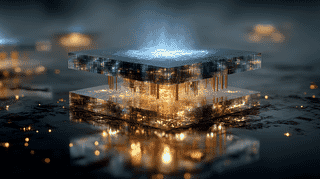
The world's first factory built to mass-produce diamond semiconductors has opened in Okuma, the Fukushima town that hosts the wrecked Daiichi nuclear plant. How a material researchers chased for 40 years found its purpose in the place that needed it most.
Ultra-pure water is the invisible backbone of chipmaking, so clean that a stadium of it may hold less impurity than a single sugar cube. Three Japanese firms, Kurita, Organo and Nomura Micro Science, lead the world. We unpack their technical edge and the contest with global rivals like Veolia.
Asahi Kasei has developed a photosensitive polyimide film for advanced semiconductor packaging, turning a liquid material into a laminated film, the same playbook behind ABF. We explain what it means for AI chiplet packaging, how it stacks up against US and Korean rivals, and why Japan keeps winning the materials game.
At the APEC trade ministers meeting in Suzhou, China, Japan's industry minister demanded that exporting countries rectify arbitrary rare earth curbs. A look at the slow squeeze on Japan, its roots in a Taiwan remark, and Tokyo's exit strategy.
An Osaka University team has shrunk a key step in magnetic tunnel junction fabrication from hours to about 1.7 seconds using flash-lamp annealing—up to thousands of times faster than conventional methods, with implications for MRAM mass production and flexible sensors.
Kyoto University associate professor Mitsuaki Kaneko is commercializing SiC-based mixed-signal LSIs that work where silicon fails. His complementary JFET approach targets ADC samples in 2028-2029, opening a niche the big five SiC power players have largely ignored.
TSMC's Japanese subsidiary JASM posted a quarterly profit of NT$951 million (about $30 million / ¥4.78 billion) in Q1 2026, the first time the Kumamoto fab has been in the black since mass production began in December 2024. We unpack what the 14-month turnaround means against the backdrop of Japan's ¥1.23 trillion in subsidies, the Sony-Denso-Toyota partnership, TSMC's Arizona and Dresden expansions, and Rapidus's high-stakes 2nm bet.
Kioxia forecast a 48-fold jump in Q1 net profit to 869 billion yen ($5.5 billion), making the Japanese NAND maker Japan's single-largest AI beneficiary on a quarterly basis after Toyota. We unpack the US ADS listing plan, the supercycle reshaping NAND prices, the HBM gap with Samsung and SK Hynix, and what it all means for Japan's broader semiconductor revival.
Sony Semiconductor Solutions has signed an MOU with TSMC to form a next-generation image sensor joint venture. Why is the 51% market leader pairing with Taiwan instead of going it alone? We compare it with the US CHIPS Act, EU Chips Act, and Korea's K-Chips Act, and explore the Apple-Samsung tug-of-war shaping the physical-AI era.
GPU-to-GPU optical interconnects were forecast to arrive around 2033. NVIDIA just pulled them in by five years, putting co-packaged optics into the NVLink switch of its 2028 Feynman generation, and locking in supply with $2 billion investments in each of Lumentum and Coherent. Furukawa Electric is spending 38 billion yen to more than quintuple DFB laser chip capacity; Sumitomo Electric supplies core components for NVIDIA's Quantum-X Photonics switches but was left out of the funding round. Where Japan's optical suppliers stand, and how NTT's IOWN runs on a different clock.
Kioxia and Sandisk have achieved a world-first technological milestone toward 3D NAND flash memory exceeding 1,000 layers. Their multi-stacked cell array CMOS (MSA-CBA) structure with wafer-to-wafer Cu direct bonding successfully demonstrated QLC operation, and will be unveiled at the VLSI Symposium 2026 in Hawaii this June. We break down the technology, the three-way stacking race against Samsung, SK hynix, and Micron, and what soaring AI data center demand means for the NAND market.