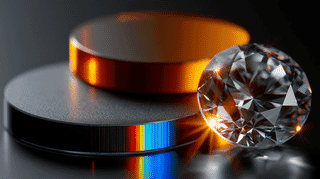
Tokyo's Orbray and De Beers' Element Six have established a reproducible process for one of the largest single-crystal diamond wafers yet, at three inches. How a sapphire trick beat the cracking problem that long held back diamond, the material many call the ultimate semiconductor.
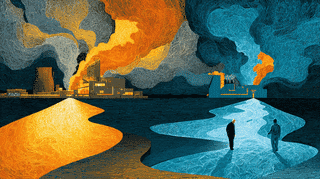
TSMC, the world's largest foundry, is quitting GaN power-chip manufacturing. ROHM, which built its flagship 650V parts inside TSMC's fabs, has licensed the technology and is racing to mass-produce in Hamamatsu by 2027. A look at the China-US rivalry and Japan's vertical-integration bet.
A team led by Japan's QST has shown, for the first time, a magnetic memory that writes with a laser pulse instead of current, and made it work on CoFeB, the alloy already inside commercial chips. Here's how, and why it matters for data-center power.
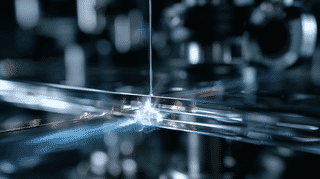
RIKEN and Enplas drill 1.1-micron, aspect-ratio-1,000 holes through glass in under a nanosecond, hitting 3,000 holes a second. As the chip race shifts from shrinking to packaging, here's why glass through-glass vias matter, and where Japan's materials and equipment makers fit.
Tokyo Ohka Kogyo is No. 1 in photoresist with a 24.7% share and No. 2 in EUV resist with 28%. How a 1936 maker of coal-lamp battery material became a chokepoint in the AI chip supply chain.
Intel installed the first production-grade High-NA EUV machine; TSMC bought one but kept it out of production. Being slow to the newest lithography once cost Intel a lost decade. Is TSMC repeating that mistake? Its confidence rests on Japan: Mitsui Chemicals' EUV pellicle and the HOYA/Shin-Etsu/AGC mask-blank near-monopoly (about 90% share).
Mitsui Chemicals was first in the world to mass-produce the EUV pellicle, a free-standing film tens of nanometers thick. From the ASML license to the carbon-nanotube pivot and a 2027 upgrade, here is why one invisible bottleneck sits with a single Japanese plant.
Not TSMC, not ASML. A Japanese chemical maker with ~$240M in sales quietly supplies about 70% of the world's photoresist sensitizer: the ingredient inside the ingredient that prints every advanced chip.
JX Advanced Metals, maker of roughly 60% of the world's sputtering targets, is investing about 23 billion yen to expand its Hitachinaka plant by 1.6x and selling its Chilean copper mine stake to Lundin Mining for $215 million, redirecting the cash into chip materials. A look at a 120-year-old miner remaking itself as an advanced-materials company.
A fresh 150-billion-yen government injection pushes the state's share of Rapidus's capital to roughly 60%. Yet Tokyo capped its voting rights at 11.5%, keeping the firm out of state-enterprise territory by design. We unpack subsidies versus equity, the fate of the 2nm skeptics, and the question of who will actually buy the chips.
ROHM and Quanmatic put quantum annealing to work on a chip fab's front-end process, lifting output about 3%. Here's why a number that sounds small is actually a big deal on a factory floor.