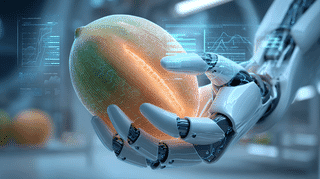
Shibaura Institute of Technology's "InSIGHT Grip" is a non-destructive inspection technology that estimates internal quality simply by gripping objects with a robot hand. With a low-cost, sensor-free design, it promises applications from fruit sorting in agriculture to industrial deterioration detection.
Tufts University researchers have developed a new, lower-cost way to produce tagatose, a rare sugar 92% as sweet as table sugar with 60% fewer calories. It has little effect on blood sugar, holds FDA GRAS status and browns like sugar in baking. Here is what it could mean, and what still stands in the way.
Japan's bamboo forests cover roughly 400,000 acres, and unmanaged groves keep spreading, raising landslide risks and damaging ecosystems. Taguchi Industrial from Okayama has answered with the "TakeKaruGon" - a domestically-made mulcher attachment for hydraulic excavators that shreds bamboo, large trees, and stumps in one machine. Discover how this innovation tackles one of Japan's most overlooked environmental crises.
Japanese startup AirX has signed a binding order with Brazil's Eve Air Mobility for two eVTOL "flying car" aircraft, with options to expand to 50 units in a deal potentially worth $150 million. Targeting 2029 for sightseeing and last-mile transport services in Tokyo and Osaka, this agreement marks a major milestone in Japan's push toward urban air mobility — following successful demo flights at Expo 2025 Osaka.
Japan's first nuclear-powered ship "Mutsu," launched in 1969, was plagued by a radiation leak incident and fierce public opposition. Yet engineers cut the hull apart, removed the reactor, and spent roughly $1.3 billion (in today's value) transforming it into "Mirai" — one of the world's largest ocean research vessels. Over 28 years, Mirai sailed 2.3 million km (58 trips around Earth), pioneered Arctic research, and even surveyed Fukushima's nuclear contamination. Retired in December 2025, its story of dramatic reinvention now passes the torch to the icebreaking successor "Mirai II."
Japanese startup AstroX has raised $15 million in Series A funding to develop its revolutionary Rockoon launch system — using high-altitude balloons to carry rockets to the stratosphere before firing them into space. Based in Fukushima's Minamisoma, the company aims to reach space by 2026 and achieve orbital insertion by 2029, challenging the global space launch industry with a low-cost, flexible alternative.
A joint team from Chiba University, NHK Science & Technology Research Labs, and Kyoto University has developed an organic EL device capable of both light emission and solar power generation. Using innovative MR-TADF materials, they overcame the long-standing trade-off between emission and power conversion efficiency, achieving the world's first blue light-emitting power-generating device. Applications include self-powered displays and battery-free sensors.
Adobe reversed its decision to kill Adobe Animate just two days after the announcement. Behind the reversal: fierce backlash from creators and animation studios worldwide, including Japan's Science SARU. The share price also fell after the announcement. What does "maintenance mode" really mean for the future of 2D animation?
TSMC upgrades its Kumamoto Fab 2 from 7nm to cutting-edge 3nm production, targeting mass production by 2028 with $17 billion investment. CEO C.C. Wei personally briefed Japan's PM Takaichi on the plan. We analyze what this means for Japan's semiconductor revival, AI infrastructure, and global chip supply chain diversification.
Pre-launch leaks pointed to a 7.8-inch inner display and the return of Touch ID for Apple's first foldable iPhone, which was officially unveiled as the iPhone Duo on September 9, 2026. How will a phone priced around $2,000 land in Japan, where iPhone dominates? A look at the leaks and the foldable market.
Ibiden, the dominant supplier of IC package substrates to NVIDIA and Intel, has announced a massive $3.2 billion investment plan over three years to boost production capacity 2.5x. Discover how this Japanese manufacturer in Gifu Prefecture is positioning itself as the backbone of the global AI infrastructure boom.