At the APEC trade ministers meeting in Suzhou, China, Japan's industry minister demanded that exporting countries rectify arbitrary rare earth curbs. A look at the slow squeeze on Japan, its roots in a Taiwan remark, and Tokyo's exit strategy.
OpenAI is moving to offer its newest cyber-focused AI model, GPT-5.5 Cyber, to the Japanese government and industry. Former NSA Director Paul Nakasone, now an OpenAI board member, flew to Tokyo to pitch critical-infrastructure cooperation. We unpack the contrast with Anthropic's tightly controlled Claude Mythos, the China-threat framing, and what it means that OpenAI wants Japan as its first international partner.
NEC has completed the East Micronesia Cable System (EMCS), a 2,250-kilometer optical submarine cable that gives three Pacific island nations their first-ever fiber connectivity. For Tarawa, Nauru, and Kosrae, roughly 100,000 people who had only known the 600-millisecond delay of satellite internet, the upgrade is transformative. The backstory is equally striking: in 2018, China's HMN Tech (formerly Huawei Marine) underbid NEC and Alcatel Submarine Networks by more than 20%. A 2020 US diplomatic warning to Micronesia, the World Bank's withdrawal, and a 2021 Japan-US-Australia rescue plan rewrote the project. Five years later, the cable is in the water.
Brazilian Foreign Minister Mauro Vieira visited Japan on May 17–19 for the inaugural Japan-Brazil Foreign Ministers' Strategic Dialogue. Here's what oil-dependent Tokyo wants from South America's resource giant amid the Hormuz crisis.
On May 18, 2026, the full content of Japan's LDP proposal for revising its three security documents was revealed. Early deployment of interceptor drones, sustained warfighting capability lasting 'at least a year,' early-warning drones over the Pacific, next-generation submarines with long-range missiles: here's what Japan's future defense posture looks like, shaped by Ukraine war lessons and China deterrence.
Kawasaki Heavy Industries has begun pitching a technology that produces naphtha, the building block of plastics, from hydrogen instead of crude oil. Built on its commercial gas-to-gasoline plant in Turkmenistan, the proposal lands in the middle of a Japanese petrochemical crisis triggered by the Strait of Hormuz disruption.
Anthropic's Head of Global Affairs Michael Sellitto arrived in Tokyo May 15 and confirmed the company is weighing participation in the cyber defense corporate alliance proposed by Japan's ruling LDP. Modeled on US Project Glasswing, the framework will test Japan's distinctive 'middle path': an AI Promotion Law with no penalties, sitting between the EU AI Act's hard regulation and the deregulatory turn under the Trump administration.
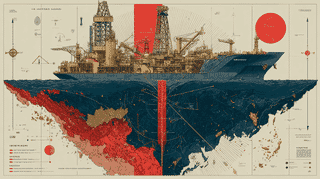
Japan's ruling LDP has asked the government to build a dedicated rare earth mining vessel for ~100 billion yen ($640M) at Minamitorishima, handing the proposal to Prime Minister Takaichi on June 12, 2026. Why JAMSTEC's Chikyu isn't enough, the roadmap from the February 2027 demonstration test to FY2028 industrialization, and how Japan's approach compares with the US, EU and Australia.
Calbee is switching 14 of its flagship snacks (including Potato Chips Lightly Salted, Consomme Punch, and Kappa Ebisen shrimp chips) to monochrome 'petroleum-saving packages' from May 25. The cause: ink shortages triggered by the Hormuz Strait crisis. A symbolic case of geopolitical risk reaching Japan's shelves, compared with parallel moves at Lindt, Lamb Weston and Smithfield Foods.
Terra Drone has unveiled flight footage of its fixed-wing interceptor drone Terra A2 — 75km range, 312km/h top speed, 40-minute endurance. CEO Toru Tokushige outlined the layered air defense vision in a United24 Media interview. Inside the modern methods of stopping Shahed-type kamikaze drones and the new air defense economics being shaped by a Japanese startup.
On May 8, 2026, the US Department of War launched war.gov/UFO and released 162 UAP files in one go—including a football-shaped object filmed near Japan by Indo-Pacific Command in January 2023, Apollo 12 and 17 lunar surface photos, and orange orbs agents compared to the 'Eye of Sauron'. We break down what is actually in the release and how Japan is reacting, from yakisoba puns to distraction-theory skepticism.