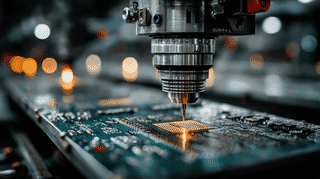
As AI growth makes chip power consumption a critical global issue, Japan's next-generation chip technologies are drawing attention. Tohoku University's MRAM cuts power consumption to a hundredth of conventional chips, while the diamond semiconductors led by Saga University have hit 120 GHz operation and are heading toward space and 6G applications. A report on Japan's technological edge and the competition with the US and China.
China's Commerce Ministry banned dual-use exports to 20 Japanese defense entities including Mitsubishi Shipbuilding, Kawasaki Heavy's aerospace arm, IHI Aerospace and JAXA, while adding 20 more firms such as Subaru and TDK to a watch list. Seen as a response to PM Takaichi's Taiwan remarks, the move puts rare earth and semiconductor material supply chains at risk. The list was expanded again in June 2026.
As AI demand pushes terrestrial data centers toward their limits in power and cooling, a new frontier is opening in orbit. Japan's NTT Group and SKY Perfect JSAT are moving first through their joint venture Space Compass, built on the IOWN optical platform, while Google's Project Suncatcher and the startup Starcloud race to put solar-powered AI infrastructure in space. Inside Japan's edge in inter-satellite optical links, and the radiation, cooling and launch-cost problems still unsolved.
Osaka University spinoff Reimei has launched the world's first corporate clinical trial of a corneal epithelial cell sheet made from donor-derived iPS cells, with the first transplant performed on July 9, 2026. How the approach could ease the global corneal donor shortage, what the Lancet-published first-in-human data showed, and where Japan's regenerative medicine regulation stands against the US FDA.
Auto mechanics in Japan now out-earn general office clerks, a reversal driven by severe labor shortages. Recruit Works Institute data across 145 occupations shows mechanics averaging ¥4.80 million against ¥4.67 million for clerks, with blue-collar pay rising far faster than desk work. Japan's belief that a degree plus a desk job equals higher income is under strain. We compare the shift with the US and Germany.
Japan Fintech Week 2026 kicks off in Tokyo. From Japan's first deposit-backed stablecoin to SBI's $65M blockchain bond with XRP rewards, plus crypto regulation reform and digital yen developments. Here's what is reshaping Japan's financial future.
Canon is launching its first new KrF lithography system in 14 years, boosting throughput by 30% to challenge ASML's dominance. With a global NAND shortage creating opportunity and a $330 million factory expansion underway, Canon's multi-front strategy, including nanoimprint lithography and ArF dry re-entry, signals Japan's semiconductor equipment counterattack.
Japan's shadow banking sector is sending warning signals. With nonbank financial risks growing, real estate lending surpassing $730 billion, and credit risks shifting under BOJ rate hikes, we analyze the parallels with China's shadow banking crisis and US commercial real estate risks, plus how Japan's regulators are responding.
The "joints" (actuators) that humanoid robots need over 50 of per unit are the key to industry dominance. These critical components account for up to 60% of manufacturing costs, and two Japanese companies, Harmonic Drive Systems and Nabtesco, dominate the high-precision reducer market, each leading its own reducer type. As the market grows at 80% annually and mega-corporations from the US, China, and Korea enter the race, can Japan defend its "joint hegemony"?
Japan's Ministry of Defense has signed a landmark $1.8 billion contract for a satellite constellation project. A special purpose company "TriSat Constellation," formed by Mitsubishi Electric, SKY Perfect JSAT, and Mitsui, will lead the effort alongside domestic space startups like Synspective and iQPS. A deep dive into Japan's pivotal shift in space defense strategy.
Japan is running its largest postwar industrial policy: over 10 trillion yen for semiconductors and AI through fiscal 2030, defense at 2% of GDP two years early, and 20 trillion yen in GX transition bonds. Rapidus at 2nm, TSMC Kumamoto's shift to 3nm, 14 niche global leaders, and where it stood in mid-2026.