Researchers at Japan's Shinshu University and JST have built a hybrid nanosheet that folds all three of nature's color mechanisms — absorption, reflection and emission — into one self-assembling photonic crystal, with color switchable by magnet or light. It is also the story of a scientist chasing 'living materials' at a textile faculty whose roots reach back to a 1910 silkworm school.
Asahi Kasei has developed a photosensitive polyimide film for advanced semiconductor packaging, turning a liquid material into a laminated film, the same playbook behind ABF. We explain what it means for AI chiplet packaging, how it stacks up against US and Korean rivals, and why Japan keeps winning the materials game.
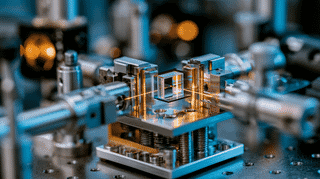
Kyoto Institute of Technology and JST have demonstrated a spinor condensate at room temperature, a quantum state once confined to cryogenic cold. Here is what it means for light-based quantum devices and Japan's distinct path versus Google and USTC.
A team led by the Nagoya Institute of Technology has found that water vapor can accelerate bond exchange in vitrimers, a third class of plastic that could finally make 'unrecyclable' thermosets repairable and reusable.
Waseda University and Fujitsu used quantum circuit learning (QCL) to predict the hardness of high-entropy alloys from only about 100 data points. We explain how a quantum approach tackles the small-data extrapolation problem that defeats conventional machine learning, where it sits against IBM and Google quantum efforts, and what it could mean for industrial materials discovery.
Kawasaki Heavy Industries has begun pitching a technology that produces naphtha, the building block of plastics, from hydrogen instead of crude oil. Built on its commercial gas-to-gasoline plant in Turkmenistan, the proposal lands in the middle of a Japanese petrochemical crisis triggered by the Strait of Hormuz disruption.
A black, sponge-like slab that floats with just lamp light has racked up 1.8 million views in a week. Developed at Nagoya University by Tomonaga Ueno, the carbon-nanotube aerogel is lighter than air and could quietly reshape EVs, eVTOL aircraft, drones and spacecraft. Here's how it actually works, and why the startup Sora Material thinks it's an industrial workhorse, not just a viral trick.
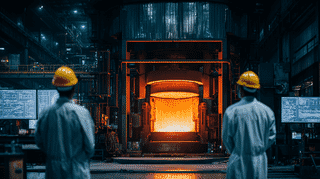
Japan's vacuum equipment leader ULVAC is reshoring production of vacuum melting furnaces for rare earth magnets, with orders from US and European manufacturers projected to roughly triple. With over 70% global share in continuous vacuum furnaces, Japan's equipment dominance becomes a geopolitical asset.
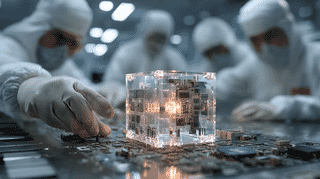
Kao, famous for Biore and Attack, has brought its first overseas semiconductor cleaning center online in Hsinchu, Taiwan. Ajinomoto, the MSG maker, is putting over 25 billion yen into ABF insulation films that hold nearly 100% global share, and has bought land in Gifu for a third plant. How Japanese consumer goods companies, alongside Shin-Etsu, SUMCO, JSR and TOK, became indispensable to the AI chip supply chain, and how they compete with US, European, Korean, Taiwanese and Chinese rivals.
Resonac, the world's top supplier of back-end semiconductor materials, has fully launched US-JOINT, a 12-company Japan-US consortium R&D center in Union City, California. The goal: cut proof-of-concept cycles from six months to one, and plug directly into the custom AI chip development of GAFAM-class hyperscalers.
Susumu Kitagawa of Kyoto University, joint winner of the 2025 Nobel Prize in Chemistry, has long advocated turning air itself into a resource through metal-organic frameworks (MOFs). His porous crystals can sort and capture CO2, water vapor and other molecules, putting Japan in direct conversation with players like Switzerland's Climeworks in the rapidly evolving direct-air-capture industry. Here is how a basic-science breakthrough from Kyoto could rewrite the economics of decarbonization.