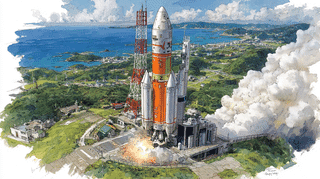
Japan's new cargo ship HTV-X1 reentered the atmosphere on the night of May 26, 2026, completing a roughly seven-month mission (JAXA announced it the next day). In its final two and a half months it gathered on-orbit data on next-gen space solar cells, including a domestic perovskite made by Ricoh, and received a radio signal from the ground. Here's why perovskite in space is a different story from perovskite on rooftops.
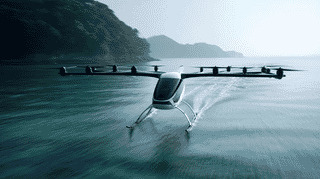
Honda's full-scale eVTOL demonstrator, designated F1, completed its first flight in the US, hovering for about 90 seconds. Instead of going all-electric, Honda chose a gas-turbine hybrid built for 400km-plus intercity range. Here's the contrarian bet, and the F1 and HondaJet technology behind it.
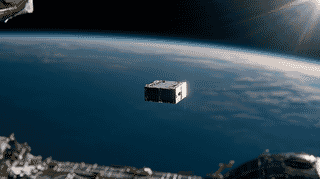
JAL, JALUX and ispace have unveiled ARGO PROJECT, the first lunar transport service run by an airline. A box called Möbius Ark will carry cultural items to the Moon on ispace's Mission 3 in 2028. Here is why a 75-year-old airline is moving into space logistics.
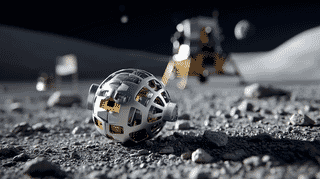
Japanese Unreal Engine studio Historia has unveiled REAL MOON Studio, a lunar digital twin recreating a 240km by 240km stretch of the Moon's south pole. Built on joint research with JAXA, it lets engineers rehearse rover routes, preview camera shots, and plan lunar bases - a look at how game-engine technology is quietly joining the global Moon race.
Tohoku University researchers have proven for the first time that microscopic surface roughness can reduce air drag by up to 43.6%, overturning an 80-year-old fluid mechanics consensus dating back to the 1940s. Here is what this discovery could enable for aircraft, cars, ships, bullet trains, and drones — and how it differs from riblets and golf ball dimples.
Terra Drone has unveiled flight footage of its fixed-wing interceptor drone Terra A2 — 75km range, 312km/h top speed, 40-minute endurance. CEO Toru Tokushige outlined the layered air defense vision in a United24 Media interview. Inside the modern methods of stopping Shahed-type kamikaze drones and the new air defense economics being shaped by a Japanese startup.
On April 13, 2029, the 450m asteroid Apophis will pass just 32,000 km above Earth. Japan and Europe are joining forces on RAMSES, the next planetary defense mission after NASA's DART. JAXA provides the infrared imager, solar panels, and H3 rocket launch as a rideshare with DESTINY+, stepping up as US budget cuts threaten its own Apophis mission.
A Japanese team led by NAOJ has detected an atmosphere on a tiny trans-Neptunian object beyond Pluto for the first time, using stellar occultation observed from three sites across Japan. Why this rewrites textbooks on the outer solar system.
Yamaguchi's premium sake brand Dassai and Japanese engineering giant Mitsubishi Heavy Industries have successfully brewed sake in space for the first time in human history. The result: a single 100ml bottle priced at $700,000. Inside the Dassai MOON Project, the long-term plan to build a brewery on the Moon, plus practical brewery-tour info for international visitors in Iwakuni, Yamaguchi.
Toshiba Energy Systems, Airbus, and Toyota are racing to commercialize superconducting motors that promise 10x the power density of conventional motors. Dubbed the 'ultimate motor,' the technology enables hydrogen aircraft and hydrogen-engine cars while leveraging Japan's decades of niche superconductor expertise. As eVTOL startups falter, why is Japan's aviation motor technology suddenly central to the global decarbonization race?
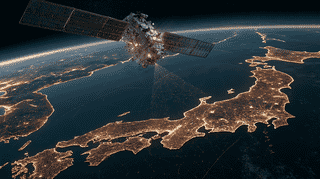
JAXA confirms H3 No.8 failure was caused by satellite adapter delamination. On June 12, the minimum 'Type 30' configuration without boosters launched successfully for the first time. Japan's environmental satellites vs China's Daqi-2.