Asahi Kasei has begun installing its Aqualyzer C3 containerized alkaline water electrolyzer in Jyväskylä, Finland — the country's first commercial hydrogen station. Backed by a Toyota-linked foundation, this marks a significant entry for Japanese electrolyzer technology into the Nordic green hydrogen market dominated by European giants like Siemens Energy and Nel ASA.
Japanese fusion startup Helical Fusion has announced that Phase 1 of its final demonstration device Helix HARUKA will be built at the National Institute for Fusion Science (NIFS). With energization tests planned for 2027, the company is betting on Japan's unique helical approach to beat global rivals including Commonwealth Fusion Systems and TAE Technologies in the race to commercial fusion power.
Japan's Financial Services Agency is tightening scrutiny of regional banks' real estate lending, which has hit a record $770 billion. As BOJ rate hikes stress the property market, we examine cross-border lending risks, lessons from Japan's bubble collapse, comparisons with the US SVB crisis, and the ongoing wave of regional bank consolidation.
PayPay, Japan's dominant mobile payment app with 73 million users, listed on Nasdaq on March 12, 2026 at $16 per share — below its initial range. Backed by cornerstone investors including ADIA, Visa, and Qatar Holding, it's the largest US IPO by a Japanese firm in a decade. We analyze Japan's cashless revolution and how PayPay compares to global rivals like Alipay and GrabPay.
Australian data center giant AirTrunk has expanded its Japan investment to over $8 billion. We analyze the paradox of how Japan's population decline is creating prime opportunities for AI infrastructure, examine the 'Data Center Ginza' cluster in Inzai, and compare Japan's position with Singapore and Southeast Asia.
Honda announces its first-ever net loss since going public, with losses of up to $43 billion from scrapping three North American Honda 0 Series EVs, acquiring LG battery joint venture assets, and writing down Chinese operations. With cumulative losses potentially reaching $157 billion, this signals a seismic shift in Japan's EV strategy. Analysis covers Toyota's hybrid vindication, the failed Nissan merger, executive pay cuts, and what it means for the global auto industry.
Japan's FSA has officially decided to shift crypto regulation from the Payment Services Act to the Financial Instruments and Exchange Act. With a flat 20% tax rate replacing the current max 55%, insider trading rules, and ETF approval on the horizon, Japan's crypto market is undergoing a historic transformation. Includes Nomura's market entry, Bybit's exit, and JPX's response.
Market consensus points to April for the BOJ's next rate hike. From the current 0.75% policy rate toward a 1.5% terminal rate, we analyze the tightening path, the Iran crisis oil shock creating a stagflation dilemma, and key points for the March 18-19 policy meeting.
Oxide Corporation, an optical crystal maker in Hokuto, Yamanashi, began selling Frequad-K, a 302nm UV laser source for quantum computers, on March 9, 2026. The wavelength is what excites ytterbium atoms into the Rydberg states neutral-atom machines need, and the first unit went to a domestic customer. We look at why 95% world share in semiconductor wafer inspection crystals transfers to quantum, and at the 436nm quantum communications laser Oxide shipped to LQUOM in July.
Sanrio is converting Harmonyland in Hiji, Oita into a stay-and-play resort under its Sky Park plan, announced December 8, 2025: 10 billion yen in initial investment, tens of billions in total, more than a decade to finish. On June 15, 2026 it acquired 30.85 hectares, growing the site roughly fivefold. Targets: one million visitors, then two million.
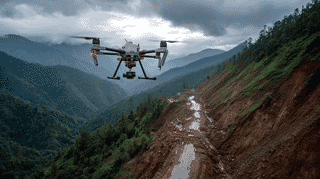
Aizawa Concrete's F3DP is a gasoline-powered drone with a robotic arm and nozzle that extrudes concrete in flight. It is aimed at printing formwork for floating offshore wind platforms by the end of 2028. A machine born from Japan's construction math: 4.77 million workers, 36.6% of them over 55.