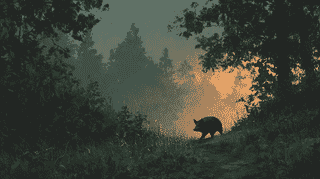
Modern wild boars still carry traces of domestic pigs brought from the Asian mainland over 2,000 years ago. Nagoya University read that story off 93 jawbones from Shimane's Nishikawazu site: escaped pigs going feral and breeding with native boars. The same thing is happening today from Texas to Brazil.
Waseda University and NTU Singapore gave a live cockroach a tiny diving suit that lets it work underwater for up to three hours. A genuine rescue breakthrough wrapped in the least reassuring messenger imaginable.
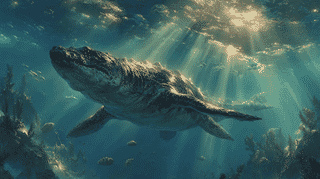
A mosasaur fossil collected in Kaizuka, Osaka and stored for 35 years has been reanalyzed. A premaxilla bone was confirmed for the first time in Japan, and the specimen may be a new species of Prognathodon, the heavy-jawed group nicknamed the T. rex of the seas.
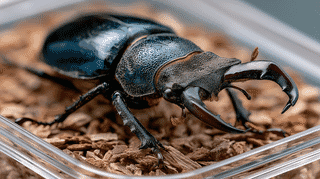
Two schoolkids on Tanegashima found a stag beetle with a female-type jaw on one side and a male-type jaw on the other. An expert says it's likely a mandible mutation, not a true gynandromorph. Here's the biology, and Japan's deep love of beetles.
Declared extinct in 1949, Japan's short-tailed albatross has rebounded to roughly 11,000 birds on the volcanic island of Torishima. We trace how decoys and recorded calls lured the seabird to safer colonies, and how the method echoes Project Puffin in Maine.
Hokkaido culls a record 157,525 deer a year, yet 730,000 remain. Inside the wolf extinction, forest and alpine damage, 5,460 car crashes, and the venison-vs-wolf debate over Japan's missing apex predator.
Anglers curse it, and it devours kelp forests. Now a patent-pending method to kill the rabbitfish's notorious stench has Japan talking. A look at turning a nuisance fish into food, and how the world is doing the same.
In 2002, Japan's Kindai University pulled off the world's first full-cycle bluefin tuna farming. Two decades on, the major seafood companies are walking away and commercial output is fading. The irony: the headwind is the recovery of wild tuna stocks. A look at the gap between sustainable and profitable.
The pygmy sweeper glows blue from its belly, yet a full read of its 625-million-letter genome turns up no gene for the light-making enzyme. A Japanese team has now confirmed, at the genome level, that the fish runs entirely on a protein stolen from its prey, the only known case of its kind, with possible payoffs for oral protein drugs.
JAMSTEC's D-ARK project filmed the first bioluminescence ever recorded inside a deep-sea cave: a glowing new zoanthid, Corallizoanthus aureus, at 385 meters off Okinawa's Daito Islands. A look at the strange ecosystem hiding in unexplored submarine karst.
It began with a particle mistaken for a bacterium in an English cooling tower. Two decades later, giant virus research in Japan has reached a startling question: where did the cell nucleus that defines us come from? A look at Furtivovirus, found in a Kamakura river.