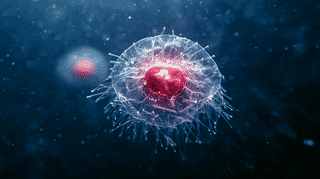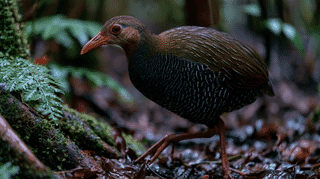
The pygmy sweeper glows blue from its belly, yet a full read of its 625-million-letter genome turns up no gene for the light-making enzyme. A Japanese team has now confirmed, at the genome level, that the fish runs entirely on a protein stolen from its prey - the only known case of its kind, with possible payoffs for oral protein drugs.
Japan discards 650,000 tons of small electronics a year, yet recovers only about 15%. The rest mostly leaks abroad through an untracked invisible flow. On June 5, 2026, the Environment Ministry picked six pilots enlisting movers and couriers to keep the metals home.
JAMSTEC's D-ARK project filmed the first bioluminescence ever recorded inside a deep-sea cave: a glowing new zoanthid, Corallizoanthus aureus, at 385 meters off Okinawa's Daito Islands. A look at the strange ecosystem hiding in unexplored submarine karst.
Dysprosium and terbium, essential to EV magnets, were China's one unbroken monopoly. In 2025, Australia's Lynas, backed by Japan since 2011, produced them outside China for the first time. What it means, and what it doesn't.
JX Advanced Metals, maker of roughly 60% of the world's sputtering targets, is investing about 23 billion yen to expand its Hitachinaka plant by 1.6x and selling its Chilean copper mine stake to Lundin Mining for $215 million, redirecting the cash into chip materials. A look at a 120-year-old miner remaking itself as an advanced-materials company.
It began with a particle mistaken for a bacterium in an English cooling tower. Two decades later, giant virus research in Japan has reached a startling question: where did the cell nucleus that defines us come from? A look at Furtivovirus, found in a Kamakura river.
A University of Tokyo-led team has produced the first high-precision genome of the Greenland shark, the longest-lived vertebrate. Changes in a linker histone and the ferritin gene offer the first real clues to its ~400-year lifespan—and to human aging.
Akita Prefecture has adopted environmental DNA surveys that estimate whether bears passed within 1km upstream in the past 24 hours from a single glass of river water. We explain how it works, its limits, and how it compares with grizzly-detection efforts abroad.
A team from Hokkaido University, Tokai University and Sapporo Maruyama Zoo has bred the slender shrew in captivity for the first time anywhere. Here is how they pulled it off with a mammal that cannot skip a meal, and why it matters for one of the smallest endangered mammals on Earth.
It has its own asteroid and is a prefectural symbol, yet for over 60 years the Musashi stickleback officially didn't exist. How an ice-age survivor near Tokyo finally became a named species, Pungitius nakamurai.
Tokai University is chasing a world-first: land-based, full-cycle aquaculture of the common octopus, long considered one of the hardest animals to farm. We unpack the cannibalism and escape problems, the clever 'octopus apartment,' the global octopus shortage behind it, and the ethical fight that has already produced farming bans abroad.