Waseda University and NTU Singapore gave a live cockroach a tiny diving suit that lets it work underwater for up to three hours. A genuine rescue breakthrough wrapped in the least reassuring messenger imaginable.
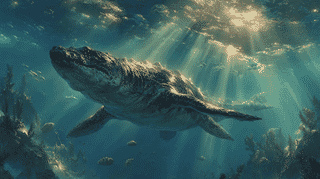
A mosasaur fossil collected in Kaizuka, Osaka and stored for 35 years has been reanalyzed. A premaxilla bone was confirmed for the first time in Japan, and the specimen may be a new species of Prognathodon, the heavy-jawed group nicknamed the T. rex of the seas.
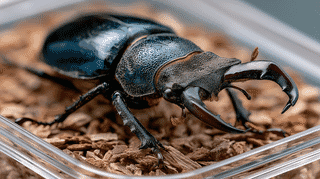
Two schoolkids on Tanegashima found a stag beetle with a female-type jaw on one side and a male-type jaw on the other. An expert says it's likely a mandible mutation, not a true gynandromorph. Here's the biology, and Japan's deep love of beetles.
Japan has rewritten its seed law to add ten years to breeders' rights and let officials block exports even before a variety is registered. We unpack the bill enacted on July 17, 2026, the suspected leak of Ehime's premium citrus to China, and why the 2020 version left a hole that fruit pirates walked right through.
Declared extinct in 1949, Japan's short-tailed albatross has rebounded to roughly 11,000 birds on the volcanic island of Torishima. We trace how decoys and recorded calls lured the seabird to safer colonies, and how the method echoes Project Puffin in Maine.
Hokkaido culls a record 157,525 deer a year, yet 730,000 remain. Inside the wolf extinction, forest and alpine damage, 5,460 car crashes, and the venison-vs-wolf debate over Japan's missing apex predator.
Kubota says its existing waste-melting furnaces destroyed three regulated PFAS at over 99.999 percent, with greenhouse-gas markers below detection. We check whether 'destroying forever chemicals' is really the breakthrough it sounds like.
Anglers curse it, and it devours kelp forests. Now a patent-pending method to kill the rabbitfish's notorious stench has Japan talking. A look at turning a nuisance fish into food, and how the world is doing the same.
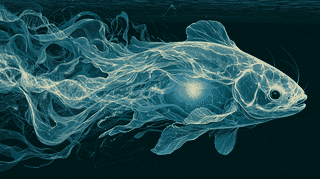
The pygmy sweeper glows blue from its belly, yet a full read of its 625-million-letter genome turns up no gene for the light-making enzyme. A Japanese team has now confirmed, at the genome level, that the fish runs entirely on a protein stolen from its prey, the only known case of its kind, with possible payoffs for oral protein drugs.
Japan discards 650,000 tons of small electronics a year, yet recovers only a little over a tenth of it. The rest mostly leaks abroad through an untracked invisible flow. On June 5, 2026, the Environment Ministry picked six pilots enlisting movers and couriers to keep the metals home.
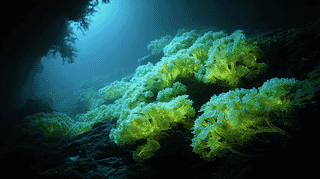
JAMSTEC's D-ARK project filmed the first bioluminescence ever recorded inside a deep-sea cave: a glowing new zoanthid, Corallizoanthus aureus, at 385 meters off Okinawa's Daito Islands. A look at the strange ecosystem hiding in unexplored submarine karst.