Researchers at Science Tokyo built a cheap biosensor that uses a plastic-binding peptide and surface plasmon resonance to detect nanoplastics in water, catching 50-nanometer polystyrene particles in 20 minutes, label-free. Here is why measurement, not the plastic itself, is the bottleneck regulators keep hitting.
Say you can hear plants and people back away slowly. Turns out it's real: researchers at Japan's Institute of Science Tokyo built a transparent 70-nanometer carbon-nanotube electrode that reads a crop's bioelectric stress signals for up to 10 months, even in the rain.
HOKUSHIN-1, a cubesat from three Japanese universities, was deployed from the ISS on June 19. Why it proves deep-space tech in low orbit first, where failure is cheap.
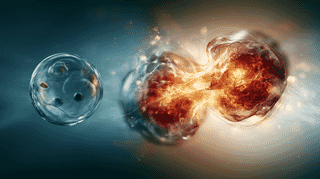
Muon-catalyzed fusion needs no plasma and no 100-million-degree heat, and it is not 1989's discredited cold fusion. A Japan-led team made the first direct observation of muonic-molecule resonance states, closing a long-standing theory-experiment gap.
A Kyushu University team showed for the first time that RPS19, long known as an anemia gene, also suppresses cancer by keeping p53 working. The finding hints at repurposing existing MDM2-inhibitor drugs.
Kubota says its existing waste-melting furnaces destroyed three regulated PFAS at over 99.999 percent, with greenhouse-gas markers below detection. We check whether 'destroying forever chemicals' is really the breakthrough it sounds like.
Since 2016, a Japan-led ALMA team kept breaking distance records for oxygen in the early universe. In 2026 they finally caught the cold neutral gas itself: [O I] 145μm in four galaxies ~13 billion years back. The decade-long quest, and how it complements the Webb-led race.
A Japanese-led team has resolved the first atomic-level structure of a metabolon, the elusive enzyme cluster that hid from biology for 40 years, revealing a new control principle called the GATE mechanism.
In a 2004 book, a Japanese paleontologist described his country's dinosaurs in modest terms. Two decades on, Kamuysaurus and Yamatosaurus put Japan on the global dinosaur map.
A Science Tokyo team finds that the brain runs multiple clocks for elapsed time, shifting between coherence and independence. From M2 and PPC recordings to the Twin-RNN model and a clue for brain-inspired AI, here's what they saw in a mouse.
Researchers in Japan made a four-micrometer sphere of chiral polymer that lases in a flat ring, like Saturn. The molecules self-assembled into a surface swirl that gives the light a direction. A clear look at the first angle-selective lasing from a sphere, driven by its own surface chemistry.
Discovered by accident during a COVID-era experiment, a University of Tokyo and Navarra study found about 65% of people drift counterclockwise when walking freely. Handedness and culture don't explain it, and even five-year-olds do it.
In 1998, Akira Furusawa achieved the world's first unconditional quantum teleportation at Caltech. For two decades, no one knew what it was for. By 2024, that same trick was running an optical quantum computer on the cloud. From the teleportation misconception to the reframe that turned it into a processor, and the startup OptQC's push for a homegrown machine.
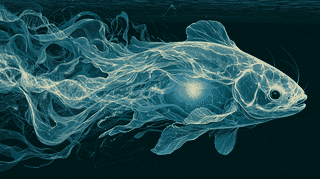
The pygmy sweeper glows blue from its belly, yet a full read of its 625-million-letter genome turns up no gene for the light-making enzyme. A Japanese team has now confirmed, at the genome level, that the fish runs entirely on a protein stolen from its prey, the only known case of its kind, with possible payoffs for oral protein drugs.
In 2004, Japanese cosmologist Katsuhiko Sato said 96% of the universe was a mystery. Twenty years and billions of galaxies later, it still is, and DESI's latest data suggests the mystery just got deeper. Here's why that's not a failure.
Over 100 researchers across six Asian countries, led by the Shenzhen Institute of Advanced Technology and including Japanese institutions such as RIKEN and Waseda, have published a 10-year roadmap to build a synthetic cell from scratch. Their two-stage ProtoCell-to-AutoCell plan and AI-driven central biofoundry mark a new approach to a question Europe and the US have chased for 20 years.
Telomelysin, a common-cold virus reprogrammed to destroy cancer cells, has won the world's first approval for esophageal cancer. It took 35 years, one surgeon's idea, and an Okayama University startup pushing through a regulatory maze.
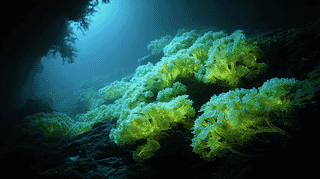
JAMSTEC's D-ARK project filmed the first bioluminescence ever recorded inside a deep-sea cave: a glowing new zoanthid, Corallizoanthus aureus, at 385 meters off Okinawa's Daito Islands. A look at the strange ecosystem hiding in unexplored submarine karst.
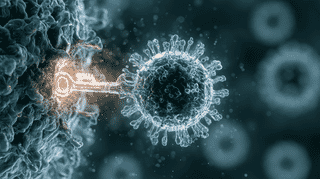
It began with a particle mistaken for a bacterium in an English cooling tower. Two decades later, giant virus research in Japan has reached a startling question: where did the cell nucleus that defines us come from? A look at Furtivovirus, found in a Kamakura river.
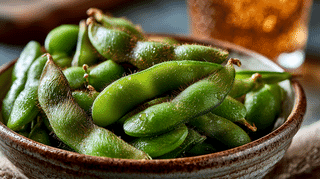
Why is Japan's prized dadachamame edamame so flavorful? Yamagata University traced it to tof11, a broken soybean gene whose accidental failure boosts umami and ripens the beans in summer.