Fujitsu successfully piloted its LLM "Takane" with a Japanese central government agency, automatically classifying and summarizing approximately 120,000 characters of public comment data in about 10 minutes. The company aims to launch a comprehensive generative AI service for policy formulation and legislation by FY2026.
A research team at Osaka University's QIQB has proposed a scalable photonic routing architecture for ion trap quantum computers. By comparing two multi-wavelength laser delivery methods, they demonstrated a path to controlling hundreds to thousands of qubits on a single chip—potentially reshaping the future of trapped-ion quantum computing.
University of Tokyo-born startup Pale Blue enters the Orbital Transfer Vehicle (OTV) business after being selected for JAXA's Space Strategy Fund. With its unique water-based propulsion technology, the company aims to create "branch line transportation" in space. A deep dive into Japan's growing space industry.
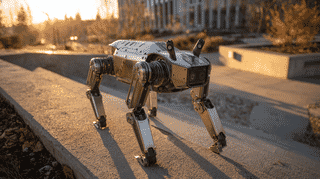
Kawasaki Heavy Industries is developing CORLEO, a four-legged personal mobility vehicle powered by hydrogen. After achieving 1.2 billion social media impressions at Osaka Expo 2025, the company targets deployment at Riyadh Expo 2030 and commercial sales by 2035. Discover the futuristic robot horse and global reactions.
Shimizu Corporation's world-class SEP vessel "BLUE WIND" has arrived in Maizuru, Kyoto. Learn about this massive 142m construction ship with 2,500-ton crane capacity and Japan's offshore wind power development projects.
Singapore startup Flint begins mass production of biodegradable paper batteries. Made from cellulose, decomposing in 6 weeks, with no lithium or cobalt. Pilot programs with Logitech and Amazon underway, AA/AAA formats expected in 2026. Could this be the solution to battery waste?
PASS (Portable Active Seismic Source), a compact seismic device developed by the University of Tokyo, has been selected for NASA's Artemis IV mission. Astronauts will use this staff-like tool to generate vibrations and map the Moon's subsurface structure. Learn how this Japanese innovation will support water resource exploration, mineral surveys, and foundation assessments for future lunar bases.
Denmark-born food waste reduction app "Too Good To Go" launched in Japan on January 28, 2026, marking its first expansion into Asia. With over 500 million meals saved across 21 countries, the "Surprise Bag" model now partners with 80+ stores including FamilyMart and Krispy Kreme in Tokyo. Learn how this win-win-win system benefits consumers, businesses, and the environment while fighting food waste.
Discover how Japanese food giant Ajinomoto dominates the global semiconductor market with its ABF insulating material. Learn the surprising story of how amino acid manufacturing expertise became essential for cutting-edge CPU production.
Japanese startup AirKamuy has developed a cardboard military drone priced at just $2,000—one-tenth the cost of conventional fixed-wing UAVs. The AirKamuy 150 assembles in 5 minutes, flies at 120 km/h for 2 hours, and is attracting attention from Japan's Ministry of Defense and Coast Guard. How is this disruptive innovation reshaping defense technology?
Mitsubishi Electric and Kyoto University have made a world-first discovery: graphite material that heals itself. HOPG's deformation resistance recovered from 41% to 97% within just 7 days. This breakthrough could revolutionize MEMS sensors in smartphones, wearables, and autonomous vehicles. A look at Japan's cutting-edge materials science.