NTT and TBS have launched the "e6 project," a joint venture to build an AI-powered theme park where stories adapt to each child in real time. Their first original IP, "Emotional Knight," will expand into anime, games, and merchandise. Explore how Japan is pioneering AI-driven edutainment to nurture children's decision-making skills.
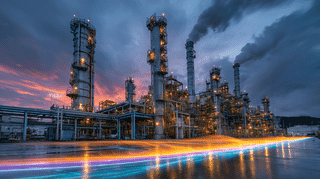
Four massive ammonia tanks—each 40 meters tall and 60 meters wide—are under construction at Japan's Hekinan Power Station. The world's first commercial-scale 20% ammonia co-firing begins in 2029, aiming to eventually replace coal entirely. Here's why it's both groundbreaking and controversial.
Aircraft carrier flight decks come in two main types: ski-jump ramps and catapult systems. Why did Japan's JS Kaga choose a flat deck instead of either? Explore the technical differences between CATOBAR and STOVL carriers, the reasoning behind Kaga's conversion for F-35B operations, and how each nation's carrier design reflects its defense strategy. What does your country think about aircraft carriers?
Japan's government launches public solicitation for regulatory barriers to AI adoption. From AI-assisted cancer screening to AI contract drafting concerns, discover how Japan is tackling regulation reform in healthcare and legal fields.
Mizuno and Kaneka's co-developed biodegradable artificial turf "Re Green Grass 9" has been installed at Vantelin Dome Nagoya — a world first for professional sports facilities. Using Kaneka's "Green Planet" biopolymer that decomposes even in seawater, this innovation tackles the growing microplastics crisis in sports infrastructure.
A Keio University study reveals CGRP antibody drugs reduced migraine frequency by half in about 50% of patients, with over 90% satisfaction. Explore Japan's latest migraine prevention treatments—from monthly injections to upcoming oral medications and neuromodulation—and how they're transforming life for migraine sufferers.
Airbus A321XLR achieves a range of 8,700km with its revolutionary structural fuel tank. American Airlines has launched commercial operations, and Japan's Peach Aviation plans to introduce it by 2028. Discover how this narrow-body jet is rewriting the rules of budget long-haul travel.
Kyoto-based SaaS company Questetra has integrated MCP (Model Context Protocol) into its no-code workflow platform. Users can now check task progress and analyze business processes simply by chatting with AI. Here's how the fusion of no-code tools and AI standards is reshaping workplace efficiency — and what people around the world think about it.
Japanese fusion startup Helical Fusion and veteran manufacturer Sugino Machine have jointly developed the world's only dedicated machine for producing high-temperature superconducting coils. Standing 6 meters tall and weighing 12 tons, this device is essential for building the "Helix HARUKA" demonstration reactor, bringing Japan closer to achieving the world's first commercial fusion power in the 2030s.
Instead of pills, prescribe connection — Japan is pioneering the use of metaverse technology as a form of "social prescribing" in healthcare. A team of 35 medical professionals and creators launched "Virtual Brave Beat" on the cluster platform, turning participants into heroes of their own story to combat isolation. We explore how the world's most aged society is leveraging virtual spaces for wellbeing.
Vema Hydrogen completes the world's first Engineered Mineral Hydrogen pilot wells in Quebec. With potential costs of $0.50/kg—a 90% reduction—and candidate sites identified in Japan's Tohoku and Kyushu regions, this technology could reshape Japan's hydrogen society vision and energy independence.