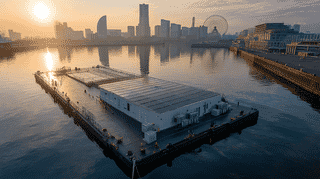
On March 25, 2026, five partners, NYK Line, NTT Facilities, Eurus Energy, MUFG Bank, and the City of Yokohama, launched a world-first floating data center powered entirely by solar panels and batteries at Yokohama Port. How does this off-grid demonstration differ from the MOL-Hitachi used-ship concept, and what does it say about Japan's answer to the AI power crisis?
On April 23, 2026, the Nikkei 225 crossed 60,000 intraday for the first time in history. We compare this milestone with the 1989 bubble peak at 38,915 yen, examining USD-based performance, the foreign ownership shift from 5% to 32.4%, the PER drop from 60x to 16x, and the heavy concentration in just a handful of AI and semiconductor stocks like SoftBank Group, which surged 9.6%.
On April 14, 2026, the headline from Nissan's long-term vision wasn't rare earths or robotaxis, it was the return of the Skyline, the continuation of the GT-R, the revival of the Xterra, and the debut of the all-new X-Trail/Rogue e-POWER and Juke EV. Here's Espinosa's 56-to-45 model cull, the new 'Heartbeat' classification, and how Japan, the US, and China each get distinct lineups as Nissan walks a standalone path after the Honda merger collapse.
Japan's government blocked Korean PE firm MBK Partners' $1.7 billion takeover of Makino Milling Machine, the first-ever stop order under the revised FEFTA since 2017. Why did a non-classified machine tool maker trigger national security alarms? We break down both sides of the overreach-versus-reasonable debate.
Japan's gasoline has hit record highs, dialysis tubing is running out, and bathtubs can't be shipped. With 95% of crude oil coming from the Middle East, pivoting to the world's largest oil producer, America, seems like a perfect Win-Win. But refinery design, tanker size, the Panama Canal bottleneck, and an ironic naphtha yield problem all stand in the way. Here's why the obvious solution isn't simple.
On April 22, 2026, the world's first global matcha industry body launched in Tokyo. Led by 28-year-old tea master Ryo Iwamoto, the International Matcha Association (IMA) brings together the CEO of the Specialty Coffee Association, UC Davis tea scholars, and Future Food Institute to tackle counterfeiting and the absence of international standards in a $4.4 billion global market.
JISDA (Japan Integrated Security Design Agency) has launched the Shiraha, a wooden fixed-wing drone costing just 70,000 yen (about 440 USD). Built on three years of field research within 20 km of Ukraine's front line, it targets Japan's training-attrition gap. How it differs from AirKamuy's cardboard drone and why Japan's defense mindset is finally shifting.
On April 21, 2026, Japan's Takaichi cabinet revised the Three Principles on Defense Equipment Transfer, officially allowing exports of lethal weapons including warships and missiles. A deep dive into what Japan's 'pacifist nation' turning point actually means.
Japanese retailer Nojima will acquire Hitachi's home appliance business for 110 billion yen (about $692 million). Here's why traditional Japanese electronics makers keep exiting consumer products, and how it echoes GE and Philips.
Sanrio pivots from licensing to in-house publishing with a new brand, Sanrio Games. First title Sanrio Party Land drops worldwide on Switch in fall 2026, with roughly 10 games planned by 2029. How it connects to the global cozy game boom.
Waymo and Toyota have agreed to explore bringing L4 robotaxi technology to personally owned vehicles. We unpack how Waymo's sensor-heavy approach differs from Tesla's camera-only FSD and China's Baidu Apollo, and what this means for Toyota's strategic direction.