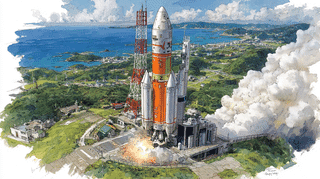
With Artemis II successfully launched, we explore Japan's crucial contributions to lunar exploration. From Toyota's Lunar Cruiser to MHI's regenerative fuel cells and Bridgestone's lunar tires, discover how Japanese technology powers humanity's return to the Moon.
Japan's shipping giant MOL and tech conglomerate Hitachi have agreed to jointly develop floating data centers by converting used ships. Using seawater cooling to slash power costs, needing no land, and deployable in just one year, these maritime server farms offer a creative answer to the AI era's insatiable appetite for computing power.
Fujitsu and Osaka University developed STAR Architecture ver. 3 and molecular model optimization to cut quantum computing resources to between 1/15 and 1/80 of conventional FTQC needs. Calculations for drug-critical Cytochrome P450 fall from 740,000 to 40,000 qubits and complete in 9 days. Comparison with IBM, Google, and IonQ's quantum drug discovery efforts included.
On March 31, 2026, NTT Docomo's 3G shutdown renders Japan's beloved garakei flip phones permanently unusable. Explore the rise and fall of Japan's unique mobile culture that gave the world emoji, mobile internet, and camera phones — and why over 500,000 users are losing their connection.
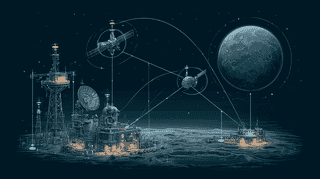
Casio and JAXA have demonstrated ±5cm positioning accuracy using LED-based visible light communication technology 'picalico' in a simulated lunar environment. With no GPS available on the Moon, this warehouse-born technology could become essential infrastructure for future lunar bases and rover operations.
Osaka University startup QuEL has demonstrated 24-hour stable operation of its quantum bit control device QuEL-1 SE, achieving amplitude standard deviation of 0.15% and phase standard deviation of 0.39°. Published in Review of Scientific Instruments, this breakthrough in device-level temperature control clears fault-tolerant thresholds crucial for scaling quantum computers toward the million-qubit era.
Sekisui Chemical has officially launched SOLAFIL, Japan's first commercially produced film-type perovskite solar cell. Lightweight and flexible enough for walls and curved surfaces, this next-gen technology positions Japan at the forefront of the global perovskite race against Chinese and European rivals.
Researchers at Osaka and Yamagata Universities have created a 'smart plastic' whose degradation can be toggled on and off with light. Using movable molecular rings, the material balances durability with biodegradability — and can even encode QR codes revealed by enzyme digestion. Published in ACS Nano.
Researchers at the University of Tokyo developed an AI model that integrates cine MRI imagery of uterine peristalsis with clinical data, significantly improving pregnancy prediction for patients with recurrent implantation failure. The novel approach condenses 18 seconds of uterine movement into a single image for deep learning analysis.
Fujitsu has developed and delivered the world's first 1-megapixel dual-band T2SL infrared sensor to Japan's defense agency, detecting temperature differences below 0.05°C. The technology, how it compares with Teledyne FLIR and L3Harris, and where Japan's dual-use defense tech strategy actually stands.
AT Tokyo and elleThermo successfully demonstrated waste heat power generation using Semiconductor-Sensitized Thermal Cells (STC) in a live data center. This Science Tokyo-born technology generates electricity directly from low-grade heat at just 30-40°C — no temperature differential required. A look at how this could reshape data center energy efficiency amid soaring AI power demands.